Doing our Job – It’s not work… It’s melacha!
There are 304,805 Hebrew letters in the Chumash – 5 Books of Moses.
That’s about 90,000 words or the length of a medium-sized novel.
It tells us the story of human civilization and Jewish history for its first 2,000 years in a very concise book. That’s a big undertaking. Yet an overwhelming part of the five books provides extreme detail of the building of the Mishkan (Tabernacle), its dedication (this weeks Torah portion) and its operation (much of the book of VaYikra – Leviticus). Why this seeming imbalance?
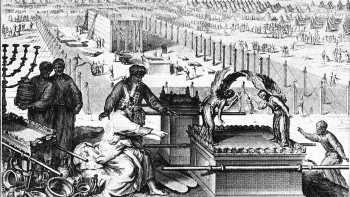 After all the materials are gathered for the construction of the Mishkan, the Jewish people set about building the vessels, materials, sockets, beams and even the clothing of the Cohen Gadol – The High Priest. Then they present it all to Moshe for assembly into the Tabernacle.
“And Moshe saw all the work (melacha), and, behold, they had done it; as the LORD had commanded, even so had they done it. And Moshe blessed them.” (Exodus 39:43)
The Shelah finds parallels in the language of the completion of the Mishkan and God’s creation of the universe… where God spent “six days” doing creative work (melacha) and on the seventh day He ceased His work and blessed it.
God’s plan in Creation was to create a world where human beings could have a relationship with Him.
He gives us the opportunity to emulate Him by instructing us to also do melacha and build a Mishkan, so that we can choose to have a relationship with Him.
Melacha is not regular work or labor. Melacha is creative activity dedicated to bringing God’s Presence into the world.
Just like God ceased doing His melacha and “rested” on the Seventh Day… so too, we cease doing our melacha and rest on the Shabbat. The Sages explain that the activities included in melacha are those specific 39 categories of activities we performed in constructing the Mishkan. (more on Melacha and Shabbat)
By ceasing our melacha for a day, it reminds us that we are not really in control of God’s presence in the world (that would be a form of idol worship where God must respond to our actions). Rather we are totally dependent on God for His blessings.
Much of our focus related to melacha is avoiding it on Shabbat. However we must remember that the Torah tells us that for “Six days shall you work, and you shall do all of your labor (melacha).” (Exodus 20:9)
Since melacha is the tool to bring God’s presence into the world, we should remember every time during the six days of the week when we send an email, turn on a light switch or drive our car, it’s an opportunity to think about God’s blessings and use it as an opportunity to bring His presence into our lives and the rest of the world.
In fact, that’s the “job” of the Jewish People.




0 Comments