What does it really mean to recite a “blessing?”
Recently I was shopping in Jerusalem at a supermarket and the Land’s bounty on display was overwhelming. What a blessing!
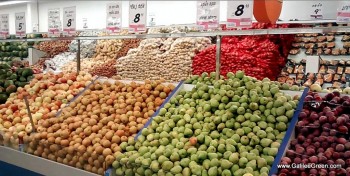 Among the huge variety of fruit we found some wonderful “Apple Pears” pictured above.
This locally grown Asian fruit is crisp, fresh and sweet with a bit of a tang. It looks like an apple but tastes more like a pear!
So what blessings do we recite when eating a luscious fruit like this?
You Shall Bless
The explicit reference in the Torah to recite a blessing related to food is here –
When you have eaten and are full, then you shall bless the Lord your God for the good land which he has given you.
– Deuteronomy 8:10
This verse clearly indicates that the blessing is to be recited “after” eating our meal. In this case, it is discussing being “full” or “satiated” after eating a proper meal where “bread is broken.” Some people read the phrase, “Bless the Lord your God” and think we are doing something to God. In fact we cannot do anything “TO” God, He is constant and unchanging. So what are we actually saying when we recite the blessing?
Source of All Blessing
In Hebrew, we begin the “Blessings after a Meal” with the words “Baruch ata Ado-nai…” — “Blessed are You, our God..” The word “Bracha” comes from the word for a bubbling spring. Therefore a blessing is a flowing forth of God’s positive influence into our physical and spiritual lives. This lovely “Apple Pear” is definitely a beautiful example of a physical blessing.
The word “baruch“ is the passive form of the word, so we are actually saying, “God, You are the Source of all blessing…” and we continue on to thank Him for providing us with a wonderful Land (of Israel) and the food that comes from it. By reciting these words of praise and thanks, we help create a loving bond between us and our Creator… which is the purpose of all mitzvahs (commandments).
Blessings Before Eating
Based on this verse, some feel we are only obligated to recite blessings after eating and not before. But you may have noticed that Torah Observant Jews also recite blessings on food “before” they eat. In fact, before biting into this delicious Apple Pear, I held it in my hand and said, “Baruch atah Ado-nai, Elo-hei-nu, Melech ha’olam, Borei pri ha’etz.” — “You are the Source of all blessing Hashem, our God, King of the Universe, who has created the fruit of the tree.”
Some think that this is unnecessary as the blessing made prior to eating is of purely rabbinic origin and has no source in the Torah. But this is not so and I will explain with a story.
God’s Kitchen
Recently we had a few of our grandchildren visiting our home in Yavne’el. One of the little ones ran to the freezer (which conveniently for toddlers at the bottom of our fridge) to take a popsicle. Her mother said, “Wait, you can’t just take a popsicle, you have to ask permission from Zaida (that’s me) first! They are his popsicles!”
The eighth of the Ten Commandments is “You shall not steal…” If we, as God’s children were to take an “Apple Pear” without acknowledging who is the Ultimate owner of the fruit, it would be like taking something that is not ours.
All God wants from us is to choose to have a relationship with Him. After we recite the blessing and acknowledge it is His fruit, He is only too happy for us to take pleasure in the bounty of His kitchen.



3 Comments
peanut butter · February 27, 2017 at 9:44 pm
The beauty of Israel, the Land and the Language!
Nili N Arnie Abrahams · February 28, 2017 at 1:49 pm
Thank you. It is a blessing!
carla baron · October 14, 2021 at 6:00 pm
I love the teaching on “what it means to recite a ‘blessing’ ” It makes perfect sense to acknowledge that everything belongs to the Creator. Our health, wealth and all the rest come from His Hand. I am “blessed” by the reminder of the 8th commandment. Bless you for sharing the this truth!